
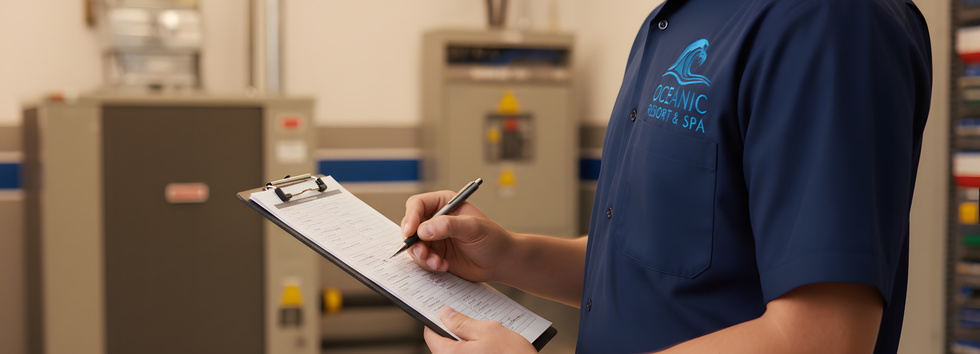
Monday, 7:00 AM. The technician starts his building walkthrough with 47 tasks in his head. By 9:00 the front desk calls: room 312's AC is dead. By 10:00 there are three more urgent calls. By lunch, he can't remember whether he checked the heating system pressure.
A hotel maintenance checklist isn't bureaucracy. It's protection from exactly that kind of day — a way to turn a sheet of checkboxes into something that genuinely saves time and heads off breakdowns.
Human memory is unreliable. Studies show: even experienced professionals skip 10-15% of items when performing routine tasks from memory. In aviation, this would lead to disasters — that's why pilots have used checklists since 1935.
In hotels the stakes are lower than in aviation, but the principle holds: system beats memory. A chief engineer who runs on technicians' "experience and intuition" gets service quality that swings from one shift to the next.
| Function | Without Checklist | With Checklist |
|---|---|---|
| Completeness | 85-90% of tasks completed | 100% of tasks documented |
| Shift Handover | "I think I did everything" | Documented proof |
| Training New Staff | Months of shadowing colleagues | Clear algorithm from day one |
| Problem Analysis | "Something breaks a lot" | Data on frequency and patterns |
| Legal Protection | Word against word | Documented history |
The main objection to checklists: "I don't have time for paperwork." Let's break down this myth.
Filling out a daily checklist with 15 items takes 5 minutes. Skipping one item — say, checking heating system pressure — can lead to a failure that takes 4-8 hours to fix.
But the real value of a maintenance checklist isn't the time it saves, it's the predictability. When every system gets checked on schedule, failures don't vanish, but they stop being surprises. And a surprise is always harder to handle than a problem you saw coming.
Different systems need checking at different intervals. A simple frequency matrix keeps it all straight:
| Frequency | Goal | What to Check | Time Required |
|---|---|---|---|
| Daily | Early detection | Visual inspection, gauge readings, critical systems | 30-60 min |
| Weekly | Function testing | Start backup systems, verify automation | 2-3 hours |
| Monthly | Prevention | Filter replacement, lubrication, cleaning | 1 day |
| Quarterly | Deep diagnostics | Sensor calibration, wear inspection | 2-3 days |
| Seasonal | Load preparation | Winter/summer transition, full HVAC check | 1 week |
| Annual | Capital audit | Equipment wear, replacement planning | 2-3 weeks |
The principle is simple: the more critical the system, the more often you check it. The fire alarm gets a daily look; decorative facade lighting can wait for the quarterly round.
A bad checklist is just a to-do list. A good one guides the technician through the work and collects data worth analyzing later.
| # | Element | Why Needed | Example |
|---|---|---|---|
| 1 | Identifier | Links to object/system | Chiller #2, serial number CH-2024-001 |
| 2 | Date and Time | Maintenance history | 01/15/2026, 08:30 AM |
| 3 | Performer | Accountability | John Smith, HVAC Technician |
| 4 | Tasks with Checkboxes | Completion tracking | ☑ Check refrigerant pressure |
| 5 | Standard Values | Assessment benchmark | Pressure: 65-80 psi |
| 6 | Actual Readings | Trend analysis data | Actual: 72 psi |
| 7 | Notes Field | Capturing nuances | "Noise at startup — check bearings" |
The closing section carries two things: an overall status (operational, needs attention, or urgent) and a supervisor signature. Without the signature it's just paper; with it, it's a document.
A technical room check is a different job from a housekeeping inspection. Housekeeping looks at cleanliness and amenities; the technician looks at whether the engineering systems actually work.
The building's engineering systems are what make every room comfortable in the first place. Keeping them on a preventive maintenance schedule isn't optional.
A paper checklist beats no checklist. But paper gets lost, never gets analyzed, and won't remind anyone about a deadline. A digital CMMS fixes all three.
| Function | Paper Checklist | CELLYPSO CMMS |
|---|---|---|
| Reminders | Calendar on the wall | Push notifications to phone |
| Photo Documentation | Separate folder with photos | Photos attached to task |
| History | Folders in archive | Search in seconds |
| Analytics | Manual counting | Automatic reports |
| Work Order Creation | Call / write | One click from checklist |
CELLYPSO CMMS lets technicians fill out checklists on their phone, standing right at the equipment. Spot a problem and a work order goes out with one tap, photo and location already attached.
Modern checklists aren't an isolated tool: