
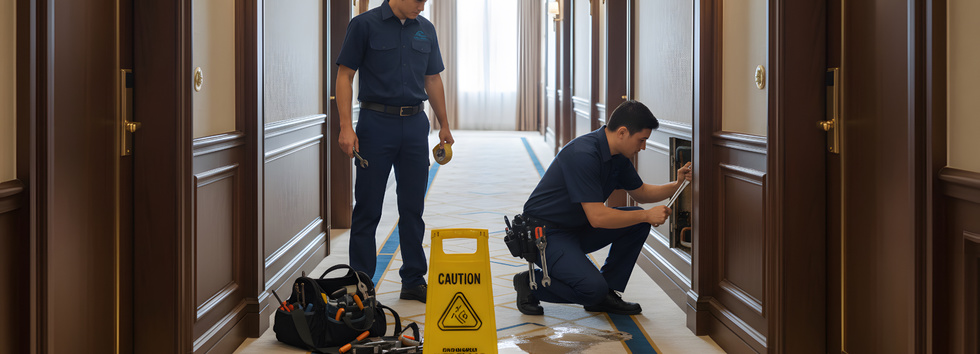
Friday, 11:47 PM. In room 812, a pipe has burst — water is flooding the ceiling of room 712. In 615, the lock won't work — a guest stands in the corridor with their luggage. In the conference room, the lights went out 15 minutes before a VIP client's morning presentation. Three problems, one shift, one technician. Hotel corrective maintenance is the art of managing chaos — and this article explains how to turn emergency repairs into a system rather than endless firefighting. Effective hotel corrective maintenance requires both rapid response and systematic planning.
In an ideal hotel, 70% of all maintenance work is planned (preventive), and only 30% is hotel corrective maintenance. This ratio isn't arbitrary — it's the result of decades of industry practice and shows the engineering department's systemic maturity.
How to interpret the balance:
| PM/CM Ratio | What It Says | What to Do |
|---|---|---|
| 80/20 | Excellent proactive service | Maintain the level, analyze for potential complacency |
| 70/30 | Healthy balance | Target state for most hotels |
| 60/40 | Room for improvement | Strengthen PM, analyze recurring failures |
| 50/50 | Firefighting mode | Urgent PM program revision needed |
| 40/60 | Crisis | Immediate management intervention required |
An important nuance: the 30% of hotel corrective maintenance should not be viewed as "failures." A portion of breakdowns is statistically inevitable — equipment ages, guests use things in unexpected ways, external factors intervene. The goal isn't zero CM, but optimal balance.
A common misconception: "Hotel corrective maintenance is unpredictable, so you can't prepare for it." In reality, most emergency work is predictable — it just hasn't been analyzed.
If you systematically collect information about breakdowns, patterns emerge:
When you know these patterns, you can prepare: schedule additional technicians for Monday mornings, proactively inspect AC units in May, plan mini-bar replacements before the failure wave. This predictive approach transforms hotel corrective maintenance from reactive chaos to proactive management.
Not all breakdowns are equal. The priority cascade helps determine what to fix first when the request queue exceeds the team's capacity.
| Priority | Criteria | Response Time | Resolution Time | Examples |
|---|---|---|---|---|
| P1 — Critical | Safety threat or total loss of functionality | Immediate | <1 hour | Fire system failure, flooding, elevator stuck with people |
| P2 — High | Significant guest impact in occupied room | <15 min | <4 hours | No AC in 90°F heat, lock won't open, no hot water |
| P3 — Medium | Inconvenience or problem in vacant room | <1 hour | <24 hours | TV doesn't work, slow drain, squeaky door |
| P4 — Low | Cosmetic issues, back-of-house areas | <4 hours | <72 hours | Scuff on wall, worn carpet, staff area repairs |
Priority can be raised based on context:
But watch the balance: if everything becomes P1, nothing is P1. The chief engineer should monitor priority inflation and adjust hotel corrective maintenance criteria when needed.
An incomplete work order is a path to mistakes. Every CM request must contain:
| # | Element | Why It's Important | Example |
|---|---|---|---|
| 1 | Location | Where to go | Room 412, bathroom |
| 2 | Problem | What to fix | Faucet drips continuously |
| 3 | Source | Who discovered | Guest complaint at 14:23 |
| 4 | Priority | Urgency | P2 — occupied room |
| 5 | Assignee | Who's responsible | Mike, plumber |
| 6 | ETA | When to expect resolution | Today by 16:00 |
| 7 | Status | Current state | In progress / Waiting for parts |
After completion, three more elements are added: actual time spent, parts used, and root cause. This data becomes the foundation for hotel corrective maintenance analysis and preventive maintenance improvements.
Hotel corrective maintenance has hidden costs that rarely get calculated:
Formula for decision-making: If preventive maintenance costs X, and hotel corrective maintenance costs 3-5X plus reputational damage, early investment always wins.
Without data, there's no hotel corrective maintenance optimization. Every work order must be recorded with time stamps, root cause, and resolution. CELLYPSO CMMS automates this collection — technicians update status from their smartphones, system tracks time automatically, all information is stored in one place.
Monthly review of CM data to find:
Analysis reveals what breaks most often. Stock those parts:
Optimal inventory: 2-week supply of high-turnover items. More = tied-up capital. Less = emergency orders.
The best hotel corrective maintenance optimization is having less CM. For each frequently failing item, ask: "Could we have caught this with scheduled inspection?" Often the answer is yes. Then add that inspection to the maintenance checklist.