
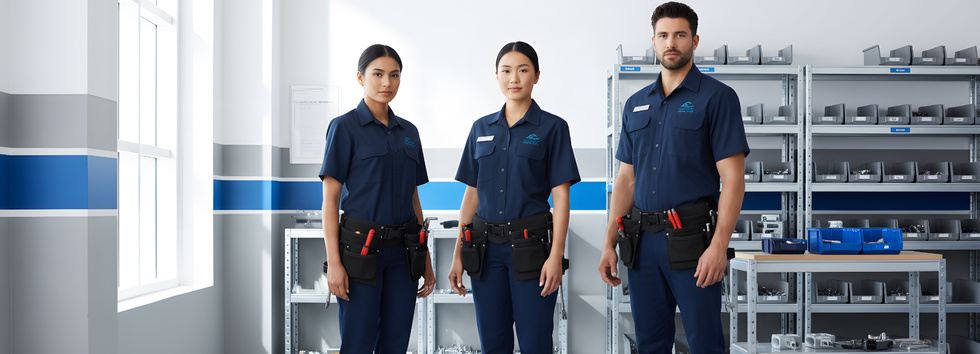
Hotel engineering staff are the people nobody notices—until something breaks. The paradox of the profession: the greatest compliment to technical personnel is when guests leave without ever thinking about them. But behind this invisibility lies a coordinated team where everyone has their role. Who belongs to this team? What skills does each position require? And most importantly—how do you build technical service personnel that transforms chaos into stability?
"Technicians go unnoticed"—a typical misconception in hotel management. In reality, hotel engineering staff interact with guests constantly. Repairs in rooms during stays, inspections at check-out, fixing complaints in the guest's presence—these are all touchpoints that shape impressions.
The numbers speak for themselves: in an average hotel, hotel engineering staff enter each occupied room 0.3-0.5 times per day. For a 200-room hotel at 70% occupancy, that's 42-70 guest interactions daily. More than the concierge.
Conclusion: the engineering department is part of service delivery, not just equipment maintenance. This affects hiring: look for people who can represent the hotel, not just hands that fix things.
Building a team of hotel engineering staff through the engineering department isn't collecting individual people—it's building a structure. Use the "Hiring Pyramid" to set priorities.
| Level | Position | Hiring Priority | Why |
|---|---|---|---|
| Top | Chief Engineer | Hired first | Builds team to their standards, sets expectations |
| Middle | Specialists (Electrician, Plumber, HVAC Technician) | Hired second | Critical competencies, hard to replace |
| Base | General Maintenance Technicians | Hired last | Easier to find and train, fewer unique requirements |
Common mistake when hiring hotel engineering staff: starting with generalists "to plug holes." The result—a team without leadership or expertise that needs to be rebuilt later.
The head of the technical department isn't the "chief repairman"—they're a process manager. Their job: make repairs happen less often, and when they do happen—faster and cheaper.
Core functions: preventive maintenance planning, budget management, contractor coordination, safety compliance, executive reporting.
Requirements: engineering degree, 5+ years technical experience, 2+ years in management. Knowledge of building systems—electrical, plumbing, HVAC, low-voltage systems.
The link between "office" and "field." The senior technician translates the chief engineer's plans into daily tasks and monitors execution.
Core functions: task assignment, quality control, new employee training, complex repair work, documentation management.
Requirements: technical degree or certification, 3+ years as technician, broad knowledge across multiple areas, leadership abilities.
Electrical systems specialist—one of the most licensed positions. An electrician's mistake can cost lives, so certification requirements are strict.
Core functions: electrical panel maintenance, lighting and outlet repairs, fault diagnosis, emergency lighting and generator work.
Requirements: electrical certification/license, appropriate safety clearance, 2+ years experience, ability to read electrical diagrams.
Water supply and drainage specialist. In a hotel, the plumber is the first line of defense against leaks—and therefore against thousands of dollars in damage.
Core functions: water system maintenance, leak and blockage repair, plumbing fixture service, pump and boiler work.
Requirements: plumbing certification/license, 2+ years experience, knowledge of materials (pipes, fittings, fixtures), welding skills for metal pipes.
Climate equipment specialist. A non-working air conditioner in July isn't just a complaint—it's a lost guest. The HVAC Technician is one of the most in-demand positions in the hotel industry.
Core functions: air conditioning and ventilation maintenance, central chiller work, refrigeration equipment diagnosis and repair.
Requirements: HVAC certification, EPA 608 certification (refrigerant handling), 2+ years experience, understanding of refrigeration principles.
The "Swiss Army knife" among hotel engineering staff. Handles everything that doesn't require specialization: minor furniture repairs, painting, light bulb changes, assisting specialists.
Core functions: minor repairs, painting work, furniture moves, basic plumbing and electrical tasks.
Requirements: high school diploma, basic skills across multiple areas, physical fitness, flexibility for shift work.
A tool for managing hotel engineering staff is the competency matrix. It shows who can do what and helps plan training and coverage.
| Skill | Electrician | Plumber | HVAC Tech | General |
|---|---|---|---|---|
| Replace outlet | ●●● | ○○○ | ●○○ | ●●○ |
| Fix leak | ○○○ | ●●● | ●○○ | ●●○ |
| Repair AC unit | ●○○ | ○○○ | ●●● | ○○○ |
| Fix furniture | ●○○ | ●○○ | ○○○ | ●●● |
| BMS work | ●●○ | ○○○ | ●●○ | ○○○ |
●●● — expert level, ●●○ — basic level, ●○○ — beginner level, ○○○ — no capability
The matrix answers the question for hotel engineering staff: "Who do we send if the electrician is sick?" For critical skills, there should be at least one backup.
When hotel engineering staff know their competencies and understand who backs them up, the team works like a machine. CELLYPSO CMMS enables digital competency matrix management, automatically selecting work order assignees based on their skills and workload.
The paradox of hotel technical services: it's easier to teach a plumber to smile than to teach a friendly person to fix pipes. But that doesn't mean soft skills can be ignored.
When hiring hotel engineering staff, evaluate more than just professional skills:
| Soft Skill | Why Important | How to Assess in Interview |
|---|---|---|
| Customer orientation | Working in rooms with guests present | Ask: "How would you explain to a guest why a repair will take an hour?" |
| Stress tolerance | Working under emergency conditions | Ask: "Tell me about your most difficult workday" |
| Communication skills | Interacting with different departments | Observe whether answers are brief or detailed |
| Attention to detail | Quality of finished work | Ask: "What do you check after completing a repair?" |
Rule: technical skills can be developed through training; character cannot. Given equal professional qualifications, choose whoever fits the team and hotel culture better.