
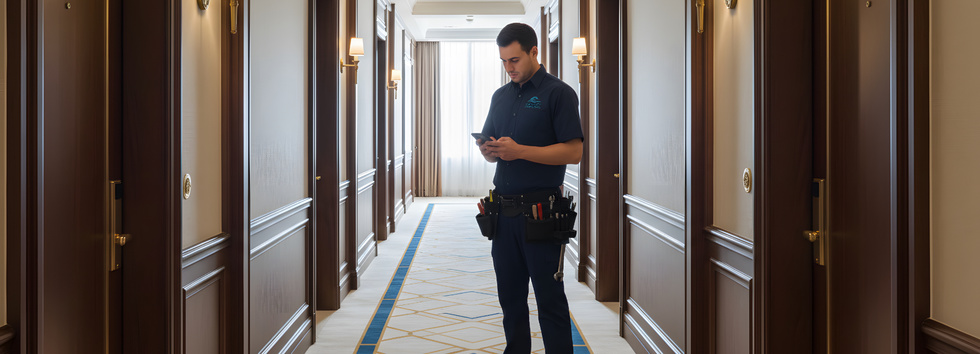
2:32 PM, a guest calls the front desk: "My air conditioning isn't working." The agent writes it on a sticky note. 2:35 PM, a call from the restaurant: "There's a leaky faucet in the kitchen." Another sticky note. By 3:00 PM, there are seven sticky notes on the desk. By 4:00 PM, three have fallen off. By 5:00 PM, the technician who came to pick up the notes takes five but doesn't notice two that fell behind the monitor. The guest waits. The faucet leaks. And nobody knows about the AC issue in room 412 — it was never written down at all.
A hotel work order is more than a form with fields — it's a binding contract between the person reporting a problem and the person who must fix it. When a front desk agent submits a request for a broken TV in room 304, a chain of accountability begins. Someone is now responsible. Someone can be held accountable. Something will happen.
Without a formal work order system, accountability dissolves. "I told someone" becomes "Someone was supposed to tell someone else." Problems exist in multiple places simultaneously: in notebooks, on whiteboards, in memories, on WhatsApp. Or they don't exist at all — because what isn't recorded doesn't exist.
The sticky note on the desk has no timestamp. The verbal request has no proof. The WhatsApp message gets lost in the chat history. A hotel work order captures who reported what, when, where, and tracks every action until resolution. When a guest complains that their request went unaddressed, the work order provides the answer. When the chief engineer needs to justify headcount, work order data tells the story.
Every hotel work order follows a predictable journey from creation to closure. Skipping stages creates gaps in accountability and makes performance analysis impossible.
| Stage | Status | Actions | Typical Duration |
|---|---|---|---|
| 1. Creation | New | Problem registration, data entry, photo attachment | 2-5 minutes |
| 2. Assignment | Assigned | Technician selection based on specialty and workload | 5-15 minutes |
| 3. Execution | In Progress | Diagnosis, repair, parts replacement | 15 min to 8 hours |
| 4. Waiting | On Hold | Awaiting parts, contractor, or guest availability | 0 to 14 days |
| 5. Review | Under Review | Quality verification, before/after comparison | 5-30 minutes |
| 6. Closure | Completed | Documentation, archiving, feedback collection | 2-5 minutes |
The "On Hold" status deserves special attention. Work orders don't disappear while waiting — they require active monitoring. A work order waiting for parts for 3 days needs follow-up: Has the part been ordered? When will it arrive? Is there an alternative solution?
An incomplete hotel work order wastes everyone's time. A technician who arrives at room 312 for a "bathroom issue" doesn't know whether to bring plumbing tools or electrical equipment. The minimum viable work order contains 12 fields.
| Work Order Number | Unique identifier for tracking |
| Creation Timestamp | Date and time with seconds precision |
| Location | Room number, area, floor |
| Problem Description | Specific issue, not generic category |
| Priority | P1-P4 based on impact |
| Status | Current lifecycle stage |
| Assigned Technician | Name and contact method |
| Equipment Category | HVAC, plumbing, electrical, etc. |
| Photo Before | Documents the problem |
| Time Spent | Labor hours for costing |
| Materials Used | Inventory tracking |
| Photo After | Proves completion quality |
The difference between "AC not working" and "AC runs but doesn't cool, room temp 28°C, guest complaint" is the difference between a 15-minute fix and a 2-hour diagnosis. Good problem descriptions save technician time.
Not every broken thing requires the same response. A water leak flooding the lobby demands immediate action. A squeaky door hinge can wait until tomorrow. The priority cascade for each hotel work order establishes clear expectations for response and resolution times.
| Priority | Response Time | Resolution Target | Examples |
|---|---|---|---|
| P1 Critical | 15 minutes | 2 hours | Water leak, power outage, guest locked out, elevator failure |
| P2 High | 1 hour | 4 hours | AC failure in occupied room, plumbing backup, hot water issue |
| P3 Medium | 4 hours | 24 hours | Burned-out lights, minor repairs in vacant rooms, squeaky door |
| P4 Low | 24 hours | 72 hours | Cosmetic defects, scheduled improvements, non-urgent requests |
Priority assignment isn't arbitrary. The key question: How does this affect the guest experience right now? A broken TV in an occupied room is P2. The same broken TV in a room out of service for renovation is P4. Context determines priority.
A hotel work order can originate from multiple channels, each with different urgency patterns and information quality. Understanding sources helps predict workload and identify recurring issues.
| Source | Typical Priority | Information Quality | Volume Share |
|---|---|---|---|
| Guest Requests | P1-P2 | Variable, often incomplete | 35-45% |
| Housekeeping Reports | P2-P3 | Good, observed during cleaning | 25-35% |
| Scheduled PM | P3-P4 | Excellent, pre-defined tasks | 15-20% |
| Inspection Findings | P2-P4 | Good, documented during rounds | 10-15% |
The balance between corrective and preventive work orders indicates maintenance maturity. A healthy ratio is 30% corrective, 70% preventive. Hotels with inverted ratios (70% corrective) are constantly fighting fires instead of preventing them. Read more about corrective maintenance and preventive maintenance approaches.
What gets measured gets managed. Hotel work order data reveals patterns invisible to the naked eye: which rooms generate the most requests, which equipment fails most often, which technicians resolve issues fastest.
| KPI | Formula | Target | Why It Matters |
|---|---|---|---|
| On-Time Completion Rate | Completed on time ÷ Total × 100 | >90% | Measures SLA adherence |
| Average Response Time | Sum of response times ÷ Count | By priority tier | Tracks urgency handling |
| First-Time Fix Rate | Fixed without rework ÷ Total × 100 | >85% | Indicates diagnosis quality |
| Repeat Work Order Rate | Same issue within 30 days ÷ Total × 100 | <5% | Reveals quality issues |
| Work Orders per Technician | Total WOs ÷ Technician FTEs | 8-15/shift | Workload balancing |
The repeat work order rate deserves special attention. If the same room generates AC complaints three times in a month, the problem isn't the technician's repair — it's the unit itself. Without work order data, this pattern remains invisible.
Paper work orders served hotels for decades, but they create information silos. The technician knows what they fixed. The front desk doesn't. The chief engineer learns about recurring issues only during monthly meetings — weeks after patterns emerge. Digital hotel work order systems eliminate these gaps.
Modern computerized maintenance management systems (CMMS) transform work order handling. When housekeeping reports a broken TV via mobile app, the work order appears instantly on the technician's phone. The chief engineer sees real-time status of all open requests. The front desk can tell a calling guest: "A technician is already on the way to your room."
A CMMS doesn't operate in isolation. Integration with the property management system (PMS) enables automatic work order creation when a guest reports an issue. Integration with inventory management tracks parts consumption. Integration with accounting converts labor hours and materials into cost reports. The work order becomes the central hub connecting maintenance operations to hotel-wide systems.
CELLYPSO CMMS connects work order management with room status, allowing housekeeping and engineering to coordinate seamlessly. When a technician marks a repair complete, the room automatically returns to the cleaning queue. No phone calls. No miscommunication. No lost sticky notes.