
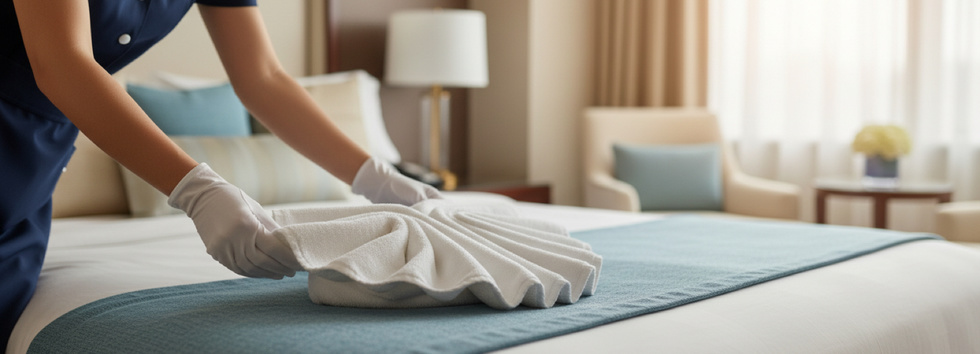
Room cleaning time is not about speed — it's about quality. When a housekeeper rushes, guests see the result: dust in corners, hair on floors, streaks on mirrors. A room like this tells the guest: "We don't care." If the hotel doesn't care about cleanliness, why should the guest care about this hotel? Let's examine how much hotel room cleaning time is really needed for quality results. Time varies by type of cleaning and is tracked in the points system.
Contents
Excessive quotas are the main cause of poor quality. The industry often cites 20-25 rooms per housekeeper per shift. Simple math reveals the problem:
8 hours ÷ 25 rooms × 60 = 19 minutes per room
This room cleaning time guarantees quality failure. In 19 minutes, it's physically impossible to:
The result of rushing: guest complaints, negative reviews, reputation damage. Insufficient room cleaning time is always visible. Better to clean fewer rooms well than many rooms poorly.
The optimal formula for calculating hotel room cleaning time standards:
8 hours ÷ 13 rooms × 60 minutes = 37 minutes per room
With 13 rooms per shift, housekeepers work at a comfortable pace without sacrificing quality. Hotel room cleaning time standards break down as follows:
| Cleaning Type | Time | Rooms per Shift |
|---|---|---|
| Stayover (occupied room) | 35-40 minutes | 12-13 |
| Checkout (departure) | 35-40 minutes | 12-13 |
| Deep clean | 90-120 minutes | 4-6 |
Important: room cleaning time allocation for stayovers and checkouts should be equal. Cutting time on occupied rooms is a mistake that compounds problems. Proper room cleaning time standards apply to all room types.
Not all rooms require equal effort. The Room Credits system accounts for this:
When calculating workload, 13 rooms means 13 credits, not 13 doors. The Room Credits system helps accurately calculate hotel room cleaning time across different room categories.
A common misconception: two housekeepers clean a room twice as fast. In practice, this doesn't work. Two housekeepers in one room get in each other's way, duplicate actions, and lose time coordinating. The result: 60-70% of expected speed, not 200%.
Exception: deep cleaning large suites where zones can be divided. Otherwise, adding staff doesn't reduce the room cleaning time required.
Hotel room cleaning steps follow a "top-down" approach with three control points:
The daily cleaning sequence in hotels:
Total: 35-40 minutes — this is the real room cleaning time needed for quality results. The daily cleaning sequence cannot be shortened — each step in the daily cleaning sequence affects the outcome.
Indicators of inadequate hotel room cleaning time:
If complaints repeat, the problem isn't housekeepers — it's the standards. Hotel room cleaning standards must allow quality work. Adequate room cleaning time allocation is a basic condition for quality.
Hotel room cleaning standards depend not only on time allocation but also on organization. Three ways to improve quality with the same staff:
Standard Operating Procedures (SOPs) — clear instructions eliminate time lost to decisions and rework.
Quality equipment — professional carts, ergonomic tools, and effective chemicals reduce physical effort. Good tools optimize hotel room cleaning time without sacrificing quality.
Housekeeping software — eliminates unnecessary calls, notes, and trips to reception. Automation optimizes room cleaning time by eliminating unproductive losses.
When housekeepers don't waste time figuring out "which room next" or "is 305 vacant," they direct that time toward quality work. CELLYPSO Housekeeping automates room assignment, shows real-time status, and maintains digital checklists — housekeepers work optimized routes while supervisors track progress online.
Room cleaning time is about respect: for the housekeeper's work, for the guest's comfort, for the hotel's reputation.