
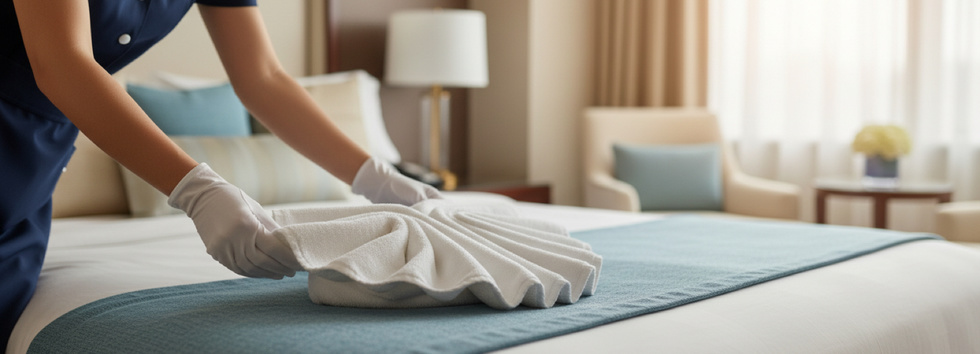
How long should it take to clean a hotel room? Long enough to do it right. Speed is not the goal here; quality is.
When a housekeeper rushes, guests notice: dust in the corners, hair on the floor, streaks on the mirror. A space like that says one thing — "we don't care." And if the hotel doesn't care, why should the guest?
The honest answer: how long a turnover takes depends on the type of cleaning, and it gets tracked in the points system.
Contents
Overloaded quotas are the number-one cause of poor quality. You will often hear 20-25 rooms per housekeeper per shift quoted as normal. The math gives the game away:
8 hours ÷ 25 rooms × 60 = 19 minutes per room
Nineteen minutes a room guarantees a bad clean. In that window, no one can realistically:
Rushing has a predictable cost: complaints, bad reviews, a dented reputation. A short-changed clean always shows. Better to clean fewer rooms well than many rooms badly.
Here is the formula we would use to set a realistic time standard:
8 hours ÷ 13 rooms × 60 minutes = 37 minutes per room
At 13 rooms a shift, housekeepers move at a steady pace and still hit the standard. The breakdown by cleaning type:
| Cleaning Type | Time | Rooms per Shift |
|---|---|---|
| Stayover (occupied room) | 35-40 minutes | 12-13 |
| Checkout (departure) | 35-40 minutes | 12-13 |
| Deep clean | 90-120 minutes | 4-6 |
One rule that gets ignored: give stayovers and checkouts the same time. Trimming minutes on occupied rooms looks efficient and quietly creates more work later. The standard applies to every room type.
Not all rooms require equal effort. The Room Credits system accounts for this:
When you plan a workload, 13 rooms means 13 credits, not 13 doors. Credits keep the time fair across categories, so a housekeeper handed three suites isn't quietly working a double shift.
A common myth: put two housekeepers on a room and it's done twice as fast. It doesn't work that way. Sharing one space, they get in each other's way, double up on tasks, and lose time coordinating. The result is 60-70% of the expected speed, not 200%.
The exception is deep-cleaning a large suite, where you can split the room into zones. Otherwise, throwing more bodies at a room won't shorten the clock.
The work runs top-down, with three checks that decide whether a room passes:
The daily cleaning sequence in hotels:
Total: 35-40 minutes. That is the real time a room needs to come out right. You can't skip a step here. Drop one and the result shows.
Tell-tale signs the clock is too tight:
When the same complaints keep coming back, the problem usually isn't the housekeepers. It's the standard they're held to. Give the work enough time and most of these signs disappear.
Quality isn't only about minutes on the clock. It's about how the work is organized. Three ways to lift it without hiring anyone:
Standard Operating Procedures (SOPs) — clear instructions cut the time lost to second-guessing and rework.
Good equipment — proper carts, ergonomic tools, and chemicals that actually work reduce the physical effort and save minutes without cutting corners.
Housekeeping software — kills the back-and-forth: no more phone calls, sticky notes, or trips to reception. The time saved goes straight back into the room.
When housekeepers aren't stuck working out "which one next" or "is 305 vacant yet," that time goes back into the work. CELLYPSO Housekeeping handles the assignments, shows live status, and keeps digital checklists, so housekeepers follow efficient routes while supervisors track progress online.
In the end, the time you give a room is a form of respect: for the housekeeper's effort, the guest's comfort, and the hotel's name.